FINAL MAJOR PROJECT
PRIMARY RESEARCH
Research Plan Document
Primary Research

For my primary research, I have created a google document, in other words, a survey for people who are interested in anime, to answer my questions. I have asked them: (What age did you watch anime for the first time and people voted 15-17, which was around 50%, 12-13, which was 25% and 14-15, which was also 25%. This suggests that people watch anime at different ages, depending on what the target audience is. As I took a look back on what my results were, according to my calculations, it shows that half of the class tend to not watch anime throughout their everyday lives.

The next question I asked them, on a scale of 1-10, how would you rate anime as, as a result I got 6 and 10 ratings from 3 people. As a result, number 10 was the largest ever rating, around 50%. As of 5 and 6, they were both 25%. It also implies to me that not everyone would waste their time recommending it to others, as there's a lot of animations out there. Overall, the 10 rating gives the audience a better understanding on how anime seems interesting to view.

Furthermore, it represents people who have weak interests in anime and they can state their own opinions about it. Sometimes, people wouldn't want to recommend anime to anyone because of how it doesn't entertain them as much. Just a moving picture.

To conclude my primary research questionnaire, I went with the last question I had in mind, which was 'What's your favourite anime series or movie to be more specific'. From this question, I received 2 responses so far from my friends in class. One of them had a lot in mind, as you can see they've listed quite a few. On the other hand, my other friend I asked, only was interested in one. Normally it depends if whether they have less interest in anime and wouldn't watch it on an everyday basis, or to give us more information to help me develop my magazine ideas with the feedback I've been given.
SECONDARY RESEARCH
These events, like Crunchyroll, target one of advertising's most coveted demographics: teens. 75% of Crunchyroll subscribers are under the age of 35, with the median free viewer aged at 18, according to the company. More than 20 million registered users watch Japanese cartoons, like Naruto Shippuden and Attack on Titan , and Asian dramas, like Boys Over Flowers, in seven languages from English to Arabic. Together, those users watch 1.5 billion minutes of streaming video every month.
29.6% of funimation's followers are female and 70.4% are male. Average engagement rate on the posts is around 0.70%. The average number of likes per post is 15364 and the average number of comments is 76. Funimation loves posting about Geek, Anime, Comics.
's readership is 30.2% people aged 25-29 years old, 26.4% people aged 20-24 years old, 25.2% people aged 15-19 years old, and 18.2% people aged 30-34. 67.5% of readers are men and 32.5% of readers are women. Weekly Shonen Jump 's print circulation dipped below two million in 2017 to 1,915,000.
For V Jump, 90% of readers are men, and 10% are women. 25% of readers are in upper elementary school, 24% are in middle school, 20% are in lower elementary school, 12% are in high school, 15% are working adults, and 4% are in college. For Saikyō Jump, 58.5% of readers are in upper elementary school, 28% are in lower middle school, 11% are in middle school, and 2.5% are in high school or older.



Secondary
Research
TECHNICAL RESEARCH
Technical
Research

ANIME CONVENTIONS/EVENTS
Anime conventions (or called anime con), is where anime fans from around the world, gather to bring the community together. Sometimes they would livestream events like these, but we don't usually find them easily, so people tend to vlog themselves attending.
I researched anime conventions and to have found out, that one of the biggest anime conventions that would bring over 100,000 people together. There's that much it's incredible. I find it actually pleasing to know that sometimes they aren't going to be the only ones who are interested, which increases the manga industry quite a lot, as the community gets bigger and remains that way. It's a pretty exciting event to visit, to be able to socialise with other people from different countries.
To my point, one of the biggest conventions out of every one in the UK, is obviously Japan. In Japan, they would say 'Comiket' to summarize, 'Comic Market'. They had around 750,000 fans, aspiring artists and cosplayers. In the UK, anime conventions normally are hosted in London West, International Centre.

.jpg)
In the source, you're able to book tickets straight away, it tells you what's going to be highlighting, such as: special guests, video gaming, stage events/talks, live music/including band gigs, parties karaoke. To link this back to my project, I feel like expanding the 'manga' topic, is entertaining people, instead of focusing on the outdoor world, it brings the anime vibe in back in 1970s. Since events like these really stand out because of: costume, loud music, bright decor, celebrities/famous voice actors and people would want to get to know more, since they won't find anime boring, but encouraging, even people would still dislike it.

MAGAZINE ANALYSIS
I came up with a plan of what I should include to help them find recommendations (my own research), what I want to show to the audience and why. I asked people who are already interested in what I am doing, so that I could receive more feedback and development with their ideas. So for this research to go according to plan, I created a google document with questions, that mentions about my magazine analysis. (Which one do they prefer/What do they like about it/Why/How does it stand out to viewers.) and about what I should include in the my magazine. For each of these questions, I have included different images and asked them the same question to see which one they prefer, so that I won't have any issues with it's layout, style and main elements. So, I either made the choice of adding manga books related to that genre (getting into more depth). Furthermore, it has given me an idea to designing magazine covers. I wanted my magazine covers to be clear and exact to it's audience, so they can understand what it says on the magazine.


I found these magazine pages to be quite useful and influential to my magazine. It doesn't take that much room on the covers and makes the central images more recognizable and clearer to see. I find it as a simple layout, not over the top. I love how each of these magazines have their own style dedicating to what the theme is. For example: The first image I got off google images, shows a massive shot of a woman posing into the camera as a medium shot, getting ready for her best position. We also have secondary images as well attached to the page, people posing in different angles, big medium or small. It gives a lot of room to the page and to the written articles.


For the contents page, I have picked out a few example templates to use for the inside. What I like about these, is that they appear more neater to the text. They've used an appropriate background colour highlight yellow, so the page appears brighter and not so boring to it's target audience. They've colour coordinated the text to match the images, so it doesn't look strange and weird. You can see in the middle of the page, that there's a couple of black paint splotches, and bits of it coming out as it's been thrown onto the paper, to show excitement and giving the audience an obvious idea on how anime is being created. So there's a lot of stuff going on.
On the other hand, to your right you can see that Shonen has used another yellow background just like the other left image, but instead they have included gold stripes coming out of the characters, to show that the anime characters are ready to jump into action, which also gives it a dramatic effect. On the top of that page, you can see that they've added a mini banner to show who is presenting the magazine. It is written in a small, bold, white font which makes it look sophisticating.
Also to not forget, a small, blue rectangular shape has been added too which slightly covers the other side of the banner, so that they can make the target audience move over to something intense or exciting instead of facing boring details. There are other mini banners in there too.
The overall meaning of that contents page, is that they are giving us a heads up to what the viewer is going to read later on when Shonen publishes. Almost like a spoiler.
Contextual
Research
Magazine Analysis
RESPONSE TO QUESTIONNAIRE


HISTORY
Not all anime have the same drawing style, because every animator produces their work in their unique way. For example, the evolution of anime 70s-90s style was really different, because of the programme they used during that time. We can compare the both images to 2021 style or 70s.
The earliest examples of Japanese animation can be traced back to 1917. The defining characteristics of the anime art style we know today first emerged in the 1960s through the works of Osamu Tezuka. If you watch modern anime, you'll quickly pick up on the unique look and feel of the anime art style.

1917
The first animated film released in Japan, and therefore the first anime, was probably released in late 1916 or very early ‘17 by Shimokawa Oten, made with chalk, and less than five minutes long. The uncertainty comes from the fact that most early Japanese films were dismantled after the reels were finished. What survived that practice was largely lost with the destruction of many film studios and theaters in the Great Kanto Earthquake in 1923, destroyed in the bombings of World War 2, or simply disintegrated over time. The nitrocellulose early films were printed on was extremely flimsy and incredibly flammable – not exactly a good recipe for preservation.
.jpg)
The word "anime" is simply an abbreviation of the word "animation." In Japan, "anime" is used to refer to all animation. Everywhere else in the world, people use "anime" to refer specifically to animation from Japan. People who like anime often also enjoy Japanese comic books, known as manga.
The earliest examples of Japanese animation can be traced back to 1917. The defining characteristics of the anime art style we know today first emerged in the 1960s through the works of Osamu Tezuka.
Since anime is directed at all ages, its content goes well beyond the child-focused themes of American cartoons. You'll find anime that features epic storylines for a wide range of interests, from comedy and romance to action and science fiction.
Finally, fans of anime also know that most anime reflects many aspects of Japanese culture. From religion and nature to culture and history, anime can rarely be separated from its connection to Japanese culture.
ABOUT MANGA


I found these anime covers off google images. There happened to be so many to choose from, so I picked randomly. I have chosen to use these front covers as inspiration, because I really love how they create a blank space in-between the lines. To my point, I will explain what manga is and why people can be so obsessed with the category. For me, I've had my experiences with it. For starters, anime can come in all different forms. For example: Anime can come in movies/series, magazines/books, toys, drawings, games and of course, memes we find on social media. Furthermore, anime isn't just 2D. In other words, anime always doesn't have to look like this:
WHAT WE NORMALLY VIEW ANIME AS:

2D ANIME
WHAT WE DON'T NORMALLY VIEW ANIME AS:

3D ANIME
The following anime front covers above, show that they are the top most half 5 star rated animes throughout the years. Here are some reviews:


A brief summary of what anime is:
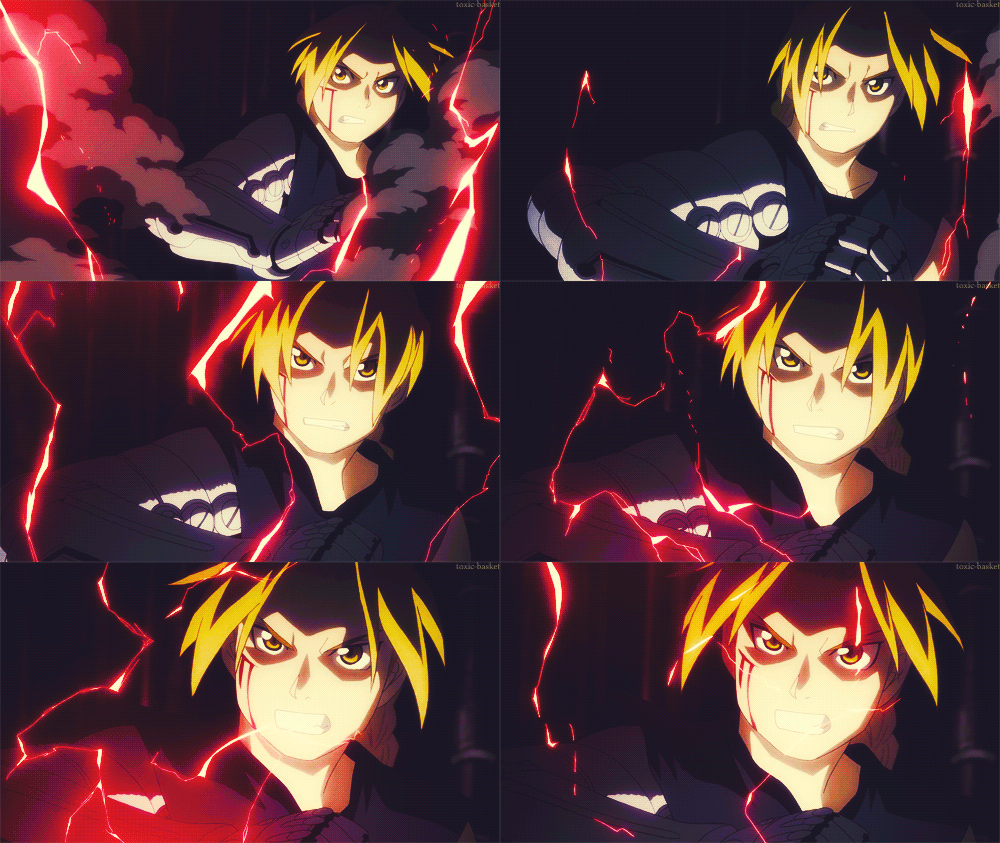
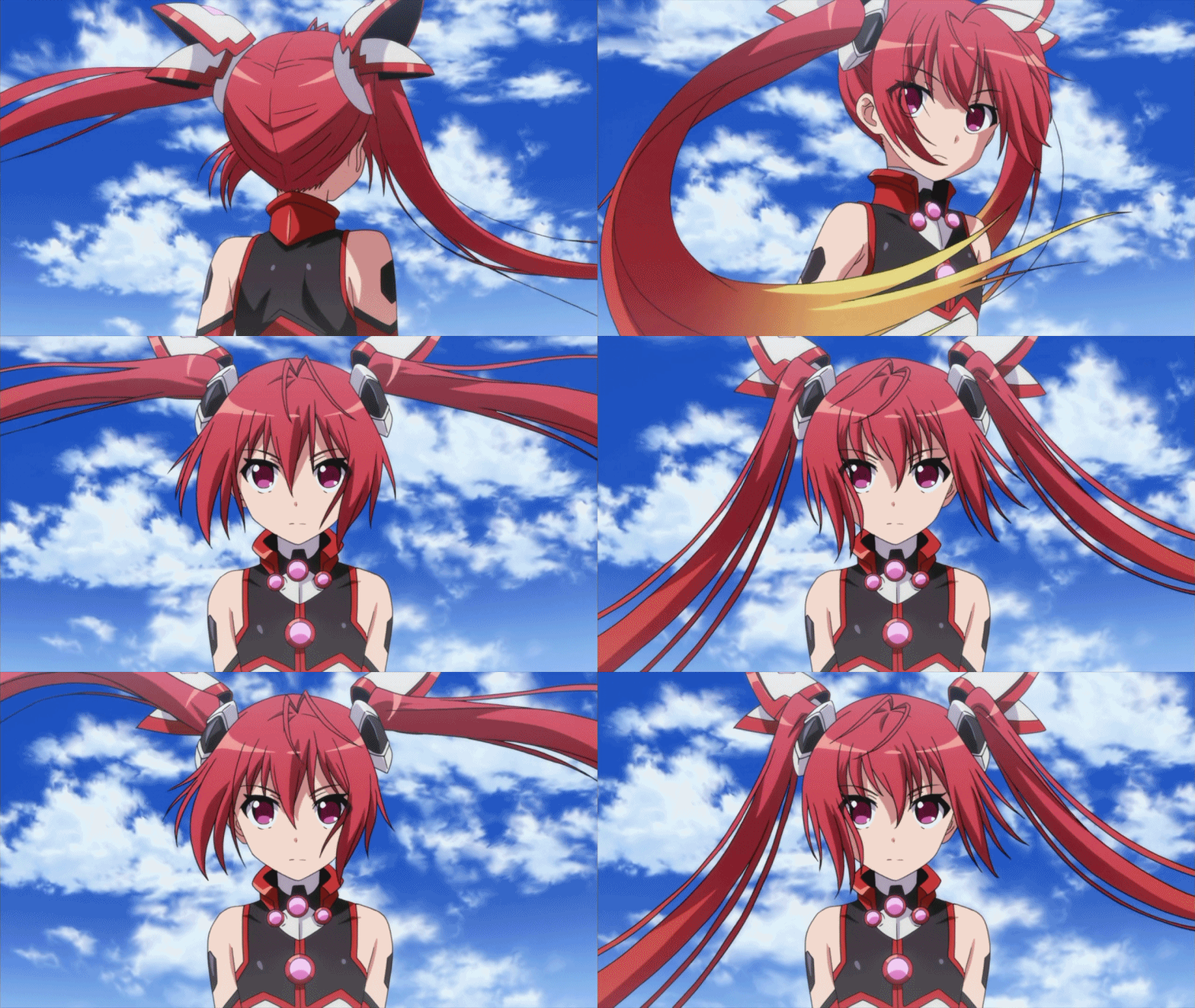
Anime is another Japanese term for animation, in other words, a moving picture. However, I think some people like to say anime because it's a word that people would normally view it as, or they feel confident with saying it and it's been mentioned most commonly inside and outside the anime community. What I mean by moving picture, is basically professional, talented drawers who work for the animation industry, make their drawings come to life basically. So I can show you an example:
When I take a look at the reviews, it can make me understand how interesting and how epic it is, even if it means I haven't watched it yet. A great understanding to the manga industry, which can help them boost their motivation into creating more yet to come. Overall, sometimes they receive negative reviews on what they don't expect in an anime series or maybe there are some scenes in there which makes them want to discuss about it or try to reflect back on the BBFC. Normally, people who respond with critical responses, happen to be uncomfortable about what is included such as (e.g. gruesome scenes, graphic content that may seem inappropriate to younger audiences, let's not forget to mention that some shots in there may cause a feeling of anxiety towards other audiences not just people under the age of 16. So we can completely understand what they are trying to prove. So furthermore, what I think, these are the top 5 star anime series throughout it's industry.
MAGAZINE IDEAS


I was finding more anime magazines on google, the result happened to be quite surprising and not so. I was expecting more results and more clearer anime magazines. So I've decided to take the liberty of going deeper. As I was scrolling through the following websites, I found so much of the same styles/colour schemes. I went onto a website called topmanhua and I found so many front cover inspirations.
Some of the book covers seemed pretty simple, so the audience can understand what the book is already going to be about. I loved how every title is positioned sometimes in the corner in different colour schemes.
The main images show the main protagonists of the story, which I mostly like about them, since they made it get straight into the point, instead of adding random images of every scene.
I love how historical the typography is, which I can perfectly understand about the time period the story was set, even if it's viewer isn't reading. I can take this book for example:


I am pretty inspired from what I have discovered throughout. Each every book I found on every slide had the same style, how the title is possible to understand, how the colours match each and every element all together. I was thinking of either using this for inspiration or do my own. In conclusion, I'll choose this, since it's very simple for it's target audience to make out. Even though the title is not so very clear to see, due to it's overlay filter, but overall, I can see how the artist is finding a way to build up his typography in his unique style.
So I have chosen to do the same for both of my front and back covers. For the article pages, I have decided to do the same for my colour scheme. I'm going to make it look more aesthetic- looking as I can possible make it.
I just think that their style is presented as clear, understandable, colourful, bright, which links with Japanese culture really well.